How it works
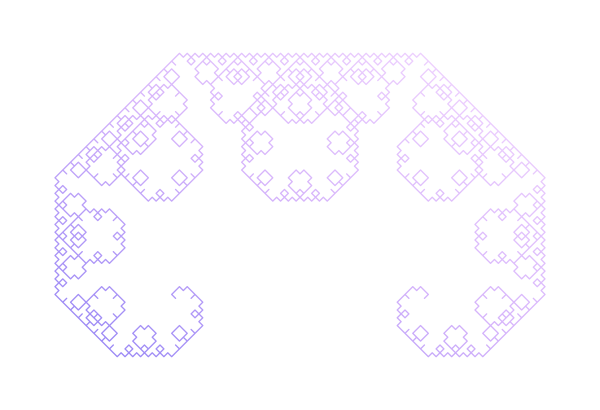
Use a line segment as the hypotenuse of a right isosceles triangle. Replace it with the triangle’s two shorter sides. Repeat for every segment with a consistent orientation. Each replacement produces two segments, each 1/√2 as long as its parent.
Where it began
The curve is named after Paul Lévy, who studied its self-similar structure in 1938. Related earlier work was published by Ernesto Cesàro in 1906 and Georg Faber in 1910.